Wood Veneer or Solid Wood: What the Surface Tells You
Learn how to tell wood veneer from solid wood at exposed edges, read grain patterns and judge furniture construction before choosing a piece.
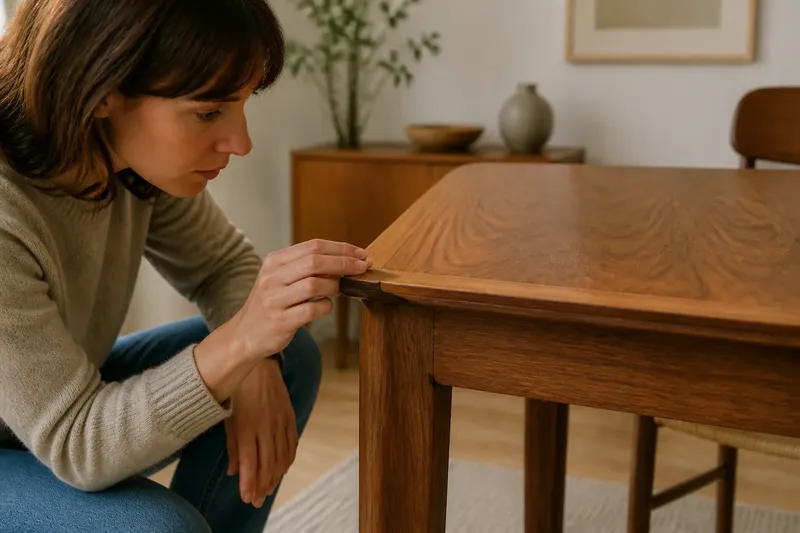
You pull a dining table away from the wall to make room for a chair, and a pale strip along its edge catches your eye. Is it solid wood, a thin veneer over a core, or a finish that only imitates timber? Wood veneer or solid wood is not a contest with a single winner: the surface can reveal how a piece is assembled, but it cannot tell you everything about its quality or suitability.
A useful inspection takes a little time and follows the furniture’s ordinary lines: broad faces, corners, undersides and edges. Treat each as a clue rather than a verdict. The aim is to understand what you are looking at before deciding whether its appearance and construction suit the way you expect to use it.
A week of looking
If you are considering a piece in a showroom or at home, a week provides a gentle structure for looking closely without turning inspection into a hurried hunt. You need no special equipment. A phone torch can help in a dim corner, and a soft cloth can clear dust from an edge, but avoid picking at a finish or using a sharp tool to test the surface.
On the first day, look at the main top or door in ordinary room light. Notice whether the grain appears to continue naturally across the face, whether it repeats, and how the colour shifts from one area to another. Veneer is real wood, sliced or peeled into a thin layer and attached to a supporting panel. Its grain may be selected and arranged deliberately, so a composed, balanced pattern does not mean it is imitation timber.
On the second day, follow the face to its perimeter. A solid board often shows end grain at an exposed end: the small, cut ends of its fibres, which can look different from the long grain on the broad face. Veneer usually turns around an edge, meets a separate strip, or stops at a banding material. Yet a well-finished edge can conceal the transition, and solid wood can also be edged or capped. One clue is not a reliable verdict.
On the third day, inspect a corner where two surfaces meet. Look for a change in grain direction, a narrow seam, a fine line, or a slight difference in colour. On a veneered panel, the veneer on the face may meet a separate veneer or solid lipping at the edge. On a solid-wood cabinet, a frame, panel or joint can also create visible boundaries. The question is not simply whether a line exists, but whether the parts make sense as a piece of construction.
On the fourth day, check an underside or an interior surface. A drawer bottom, shelf underside or back may use a different material from the visible face. A cabinet can combine solid-wood rails and legs with veneered panels; a table can have a veneered top and solid edging. Mixed construction is common and can be purposeful. Record what you can actually see rather than assigning one material to the whole object.
On the fifth day, compare repeated features. Look at several drawer fronts, doors or panels. Similar grain patterns may be the result of carefully matched veneer leaves; repetition can also come from a printed surface. Check the edge as well as the face, because a printed pattern may continue over a wrapped edge in a way that differs from real wood grain. Even then, lighting and finish can make a quick visual judgement uncertain.
On the sixth day, consider the surface’s condition. A small chip, worn corner or existing repair can expose the layers more clearly than an untouched edge. Do not create damage to find out what lies underneath. Note whether the finish is lifting, whether a seam is open, or whether a patch appears to have been made, then ask how much that condition matters to you.
On the seventh day, bring the observations together. Separate what is visible from what remains unknown. If the material affects your decision, ask the seller or maker for the stated construction, including the core, facing and edge treatment. A plain analogy helps: a veneered panel is like a book with a carefully chosen cover over its pages; seeing the cover tells you something real, but not the whole contents.
Reading an exposed edge
An exposed edge is useful because it gives the eye a view of how a panel meets its perimeter. On a solid-wood board, the end may show short, distinct fibres rather than the long lines visible on the face. On a veneered panel, the face layer may appear as a thin surface over a different core, with an edge band covering the join. The band may be wood, veneer, or another material.
Look at more than one edge, and compare places that are not finished in the same way. The front of a cabinet might be carefully banded while its underside is left plain. A tabletop may have a solid-wood border around a veneered centre. Such details can explain why the face looks continuous while the edge suggests another material.
Rounded corners, dark stains and thick coatings can hide these clues. So can a painted finish. If there is no clear transition, that is not evidence that the piece is solid; it means the edge does not answer the question. Avoid confusing a thick-looking rim with a thick slab, since an applied edge can make a panel look more substantial than its core.
Grain and construction
Veneer is genuine wood, but in a thin layer. It is commonly fixed to a stable panel such as plywood, particleboard or medium-density fibreboard. The core and the quality of the joinery matter: a clean face alone cannot establish how well a panel is made. Solid wood, meanwhile, refers to boards made from wood through their thickness, though a piece may still include joints, glued-up boards, separate edging or non-wood components.
Grain can help you understand how the surface was arranged. Veneer leaves may be placed side by side, mirrored, or selected to create a balanced figure. These patterns are intentional ways of using natural variation. Solid boards often show less uniformity across a broad surface, but a maker may select boards with closely related colour and grain. Neither a dramatic pattern nor a quiet one proves the underlying construction.
Finish changes what you see. A clear coating can deepen colour and make grain appear more pronounced; a stain can bring separate boards closer in tone or make the surface harder to read. Reflections from a polished finish may also make seams disappear from one viewing angle. Move a short distance and look again in softer light before drawing a conclusion.
Say you are choosing a small writing desk and notice that its top has a striking, symmetrical grain pattern, while the edge shows a narrow band over a panel core. The desk has solid-wood legs, and its drawer fronts appear to be veneered. If you want a broad, composed timber surface and value the visible wood across the legs, this combination may suit you; if your priority is a top that can be repeatedly reshaped or refinished, ask the maker about the veneer’s thickness and care limits before deciding.
Choosing for the room
Neither construction is automatically the better choice. Veneer can use a selected face of wood to create a consistent appearance and can be paired with a panel core. Solid wood offers material through the board, but it can still show colour variation, joints and movement with changes in its surroundings. The relevant question is how the piece is made and what kind of wear you expect, not which label sounds more substantial.
For a cabinet with broad, carefully matched doors, veneer may be a considered choice rather than a compromise. For a table whose edges will be prominent, inspect how the perimeter is built and whether it looks finished from the seats where people will see it. For a chair or desk with visible legs and rails, check those parts separately; the surface on one component does not identify every other component.
Think about future care in concrete terms. A veneer can be vulnerable if its surface is deeply gouged or if an edge begins to lift, because the exposed layer is thin. Solid wood can often be worked on through more of its thickness, but that does not mean every finish or construction can be repaired casually. Ask what cleaning products are suitable, whether the finish can be renewed, and who should handle a repair if the piece matters to you.
When the maker’s instructions, product label or local rules determine the right choice or care method, follow those rather than relying on appearance. For a costly or antique piece, a furniture conservator or qualified repairer can assess construction and condition without requiring you to probe the surface yourself.
Questions at the edge?
Can veneer be real wood?
Yes. Veneer is a thin layer of real wood attached to a supporting surface, and it can show natural grain and variation. The word describes the layer’s role in construction, not a printed imitation.
Does a visible seam mean poor quality?
No. A seam can mark a joint, an edge strip or the meeting of two panels, and its presence alone says little about workmanship. Look at whether the join is even, secure and appropriate to the design.
Can I identify a core from the face?
Usually not with confidence. A finished face conceals the layers beneath it, and a carefully matched veneer can look continuous. An exposed edge or an explicit construction description is more informative.
Which surface suits refinishing?
It depends on the finish, the material thickness and the proposed work. Solid wood may allow more material to be removed, while veneer can be damaged by aggressive sanding; ask a qualified repairer before attempting substantial refinishing.
What the surface leaves open
When you compare wood veneer or solid wood, let the visible surface answer only the questions it can answer. It can reveal grain, edge treatment, seams and signs of wear. It cannot, by itself, establish the core’s quality, the maker’s care or the piece’s future repairability. A calm look at several edges, followed by a direct question about construction, gives you a more useful basis for choosing than a label or a single attractive face.
Before you leave the piece, note one detail that would change your mind: a lifting edge, an unclear repair, or a construction description that does not match what you can see. That small distinction turns inspection into a decision you can explain, while leaving room for either material to be the right one.