The Sideboard Before the Living Room
Learn how the sideboard’s dining-room role shaped its form, and how to recognise the same useful arrangement in today’s hallways and sitting rooms.
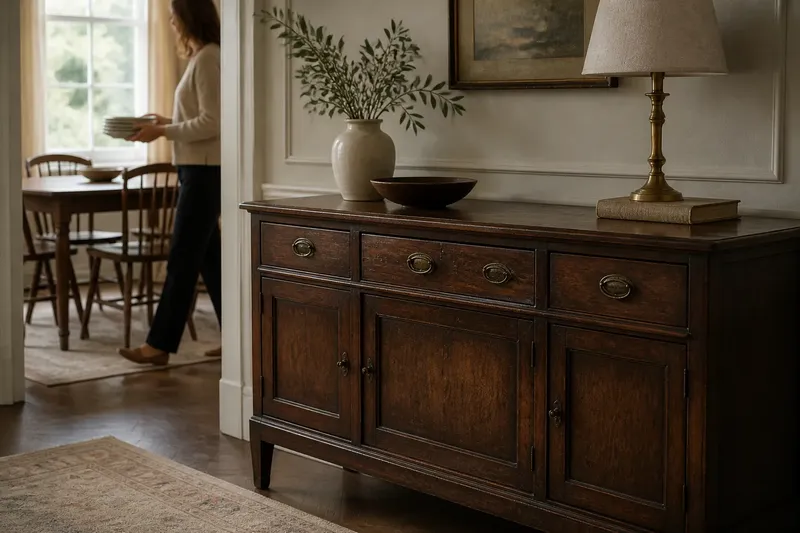
A sideboard holds the serving dishes while someone carries plates from the kitchen to the dining table. The sideboard’s dining-room role is still visible in its broad top and storage below, though the piece may now stand in a sitting room or hallway.
Dining-room service
In British domestic interiors, the sideboard is closely associated with dining-room storage and service. Its top provided a place to set dishes, while drawers and cupboards held tableware, cutlery or linen. The exact arrangement varied by maker and period; there was no single form shared by every household.
That practical relationship is a useful way to understand the piece. A sideboard was not simply a cupboard placed near a table: its top offered a working surface, and its storage kept objects for a meal close at hand. It brought together tasks that might otherwise have required separate furniture.
The name describes its position beside the dining area, but the name alone cannot establish when or where a particular piece was made. Older furniture can also be described by later or regional terms. For a specific object, construction, materials and provenance offer firmer clues than a general account of the form.
Changing forms
Sideboards have appeared in different shapes, from raised pieces on legs to broader, case-like cabinets. Some have drawers above cupboard doors; others have a simpler arrangement. These differences reflect the choices of individual makers and the needs of particular rooms, rather than a single universal sequence of development.
Nor is every low cabinet with a top necessarily a sideboard. A related piece might have been made for another purpose or acquired a different name over time. The broad top and storage beneath suggest how a sideboard could be used, but they do not by themselves prove an object’s age or original setting.
Beyond dining
Storage below and a usable surface above can suit many rooms. In a dining area, the piece might hold crockery and table linen. In a sitting room, it could contain games or papers and support a lamp. Those uses do not erase the dining association; they show how the same arrangement can serve different routines.
Think of a sideboard like a tray with drawers: its surface remains available while the contents below change. The analogy is simple, but it captures the balance between display and concealment that makes the form adaptable.
Say you inherit a broad, dark sideboard that crowds your dining area. You move it to a sitting-room wall, use its drawers for board games and leave a lamp and shallow bowl on top. The expected result is a clearer dining area and a defined place for games and lighting in the sitting room, provided the piece fits without obstructing circulation.
Related furniture
Sideboard and buffet are often used for similar low storage pieces associated with dining, and everyday usage varies. A credenza is also a low cabinet, though the word is often applied to streamlined furniture in offices or contemporary rooms. A console is generally shallower and may have little enclosed storage. A chest of drawers prioritises drawers rather than a broad serving surface.
These are tendencies, not strict rules. When a listing’s label is unclear, look at the piece itself: its height and depth, storage layout, top surface and likely use. A maker’s description can help, but it may not settle the historical identity of an older object.
Choosing a sideboard
Begin with what the room needs to hold. Drawers suit smaller objects such as cutlery or stationery; cupboards can accommodate larger dishes or folded linen, depending on their openings and interior layout. Consider the top as well: a surface intended for serving needs to be usable, while a display surface may have different demands.
- Check the wall and the entry route; if the piece cannot pass through the doorway or turn in the hall, choose a smaller cabinet or another location.
- Check the depth against the route through the room; if people would have to squeeze past, choose a shallower piece or move it to a less constrained wall.
- Check the drawer and cupboard arrangement against the intended contents; if large dishes do not fit through the openings, choose a cabinet with wider access or use it for smaller items.
- Check that doors and drawers can open without hitting nearby furniture; if they cannot, reposition the piece or select one with a more suitable layout.
- Check the top’s condition if it will hold serving dishes or a lamp; if it is unstable or damaged, avoid placing items there until the surface has been assessed or repaired appropriately.
- Check the finish and visible details beside the other furniture; if the contrast feels distracting, choose a different finish or connect the pieces with a shared colour or material elsewhere in the room.
For an older sideboard, inspect its fittings, surfaces and interior before deciding what to store in it. If the material or finish is uncertain, avoid assuming that a familiar cleaning product is suitable; seek advice from a furniture conservator when valuable or fragile finishes are involved.
Sideboard questions?
Is a sideboard only for dining rooms?
No. Its association with dining comes from its service and storage functions, but the form can also suit a sitting room, hallway or study. What matters is whether its storage and top meet the room’s needs.
Can a sideboard hold a television?
It may, if its construction and surface suit the equipment and the television can sit securely. Check cable access and ventilation, and make sure the setup does not prevent doors or drawers from opening.
Is a buffet different from a sideboard?
The terms often refer to similar pieces, and usage varies by region, maker and listing. Compare the actual shape and storage rather than relying on the name alone.
Does a sideboard need to match the dining table?
No. It can relate to the table through finish, material or shape without belonging to a matching set. In another room, a shared colour or practical role can create a connection instead.
Old purpose, new use
The sideboard’s dining-room association remains visible in the combination of a broad surface and divided storage, but that form does not dictate where it belongs. The historical record of any individual piece depends on its particular place, date and maker, not on a simple story of furniture moving from one room to another.
When looking for a sideboard, use its earlier dining role as a clue to its design, then judge the piece by the room it will serve. Its top, storage and proportions should make sense for the objects and routines you actually have.