Why a Chair’s Back Angle Changes the Way It Feels
Chair back angle shapes how a seat supports you, helping explain why a chair may feel upright, relaxed or awkward before its padding is considered.
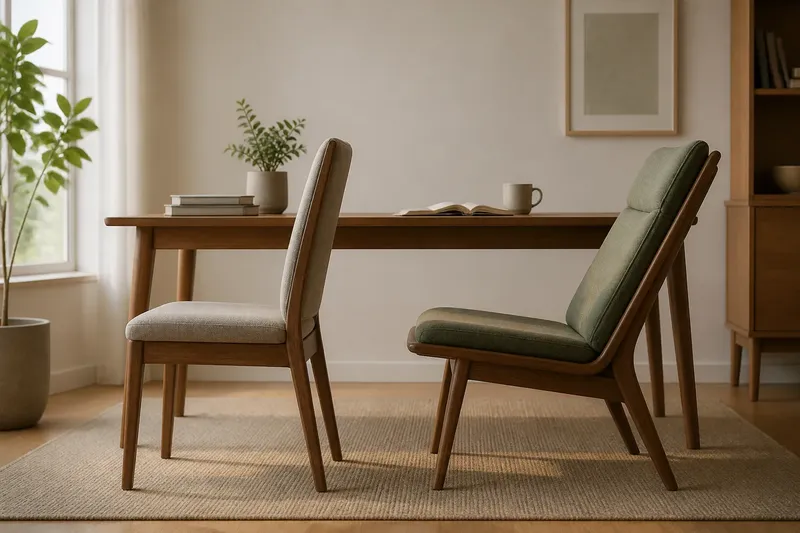
You sit down at the kitchen table to read, but your shoulders creep forward while the chair back stays behind you. The chair back angle may be part of the mismatch: its relationship to the seat changes how upright or reclined your body feels, though it cannot tell you by itself whether the chair is comfortable.
Read the geometry
Seat-to-back angle describes the meeting between the seat and the backrest. A more upright junction tends to hold the torso closer to vertical; a more open junction allows a more reclined position. The shape of the seat, the height and curve of the back, and the way the chair is used all affect what that angle feels like.
It helps to distinguish the angle of the chair from your posture in it. A sloping seat can tip your pelvis and change where your back meets the backrest. A rounded back can support one part of the spine while leaving another without contact. Even a chair with a fairly upright junction may feel relaxed if its back curves or its seat encourages a settled position.
Think of the angle like the hinge between a book’s covers: it sets how far they can open, but does not determine what fits inside. In a chair, the person, the upholstery and the rest of the frame complete the experience.
When you lean forward
If you find yourself perched at the front of a chair, the back may be too reclined for the task, or its support may sit too far behind you. You may also be reaching for a table that is too high or too far away. The angle is one possible cause, not a diagnosis on its own.
Try sitting back with both feet supported and bringing the work closer, if the room allows. Notice whether the backrest meets your torso without requiring you to lean backwards. If it does not, a chair with a more upright back or a better-positioned lumbar curve may suit desk work or meals more readily.
When the back feels distant
A reclined back can feel as though it offers little support when your body is trying to sit upright. The gap may be especially noticeable if the backrest begins low, slopes away quickly, or has a shape that does not meet your lower back. Adding a cushion can close some of that gap, but a thick cushion also moves you forward and may alter the seat depth.
Before choosing an accessory, check where the contact is missing. If the lower back is unsupported, a modest lumbar cushion may help; if the entire back feels far away, the chair’s overall recline or seat depth may be the larger issue. For an occasional reading chair, that relaxed posture may be welcome. For a chair used at a table, it can make reaching and staying upright more effortful.
When upright feels rigid
A chair that feels stiff is not necessarily too upright. Firm padding, a flat back panel, a sharp edge at the seat, or a seat that slopes towards the front can create pressure or limit comfortable movement. A backrest that meets you in the wrong place may also feel intrusive despite an otherwise suitable angle.
Notice whether discomfort comes from the junction itself or from the surfaces around it. If the back is supportive but the seat edge presses into your legs, the seat shape deserves attention. If your shoulders feel pushed forward, check the back’s curve and height as well as its recline. Changing the chair angle will not correct every mismatch.
Choosing for the task
For dining, writing or other activities that keep you near a table, an upright position usually makes reaching and facing the work straightforward. A lounge chair can use a more open angle to invite reclining. Neither arrangement is universally better: the useful question is whether the chair lets you settle into the posture you need without bracing against the frame.
Say you are choosing between two chairs for a small reading corner. One holds you nearly upright, while the other lets your shoulders lean back; imagine you want to read for a while without a desk or table in front of you. Sit in each with the book at a natural height, then check whether your back meets the support and your feet rest comfortably. The more reclined chair may suit that use if it feels supported rather than if its angle simply looks inviting.
Questions about back angles?
Does a larger angle mean more comfort?
No. A more open angle permits greater recline, but comfort also depends on seat shape, back contour, padding and the activity. A chair can feel restful to lounge in and awkward for eating or working.
Can I judge the angle by looking?
Appearance gives a rough impression, but upholstery and curved frames can obscure the seat-to-back junction. Sit in the chair and notice where the back contacts you and whether you need to shift forward or brace to stay comfortable.
Can a cushion correct a poor angle?
A cushion can change how far you sit from the backrest and where support meets your body. It may help with a local gap, but it can also shorten the usable seat or push you into a different posture.
Try before deciding
When possible, spend a few minutes sitting as you would at home rather than judging the chair from its side profile. Bring a book or sit at a table if that reflects its intended use. Check whether your back meets the support, whether your feet can rest naturally, and whether you can change position without being forced into a single pose.
The chair back angle is useful language for describing why a chair feels upright or relaxed, not a promise of comfort. When comparing chairs, treat it as one clue among the contact points and the task. That distinction makes it easier to decide whether the problem is the angle itself, the shape around it, or simply a chair designed for a different kind of sitting.